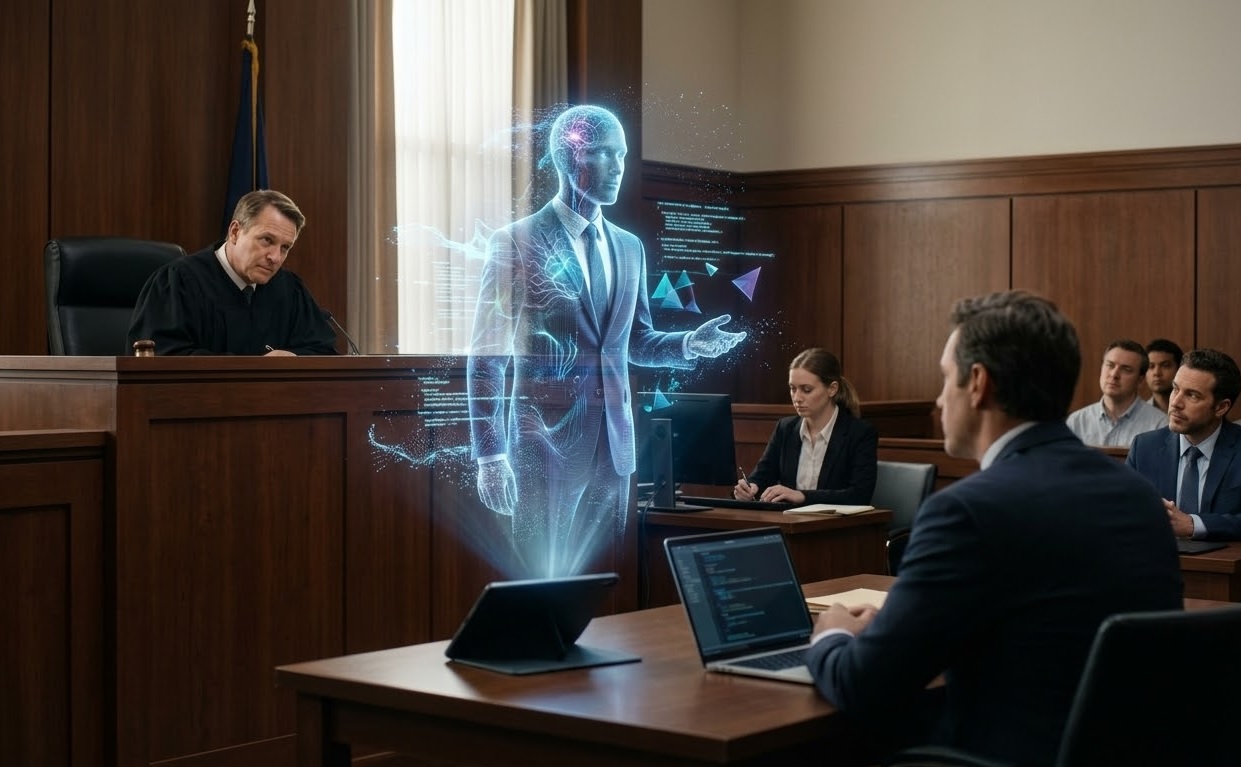
The Legal Problem Behind AI Chatbots Acting Like Lawyers
Generative AI systems can now simulate professional expertise with striking accuracy.
Legal questions.
Medical guidance.
Financial strategies.
In many cases, AI chatbots deliver responses that resemble professional advice traditionally reserved for licensed practitioners.
This raises a fundamental legal question:
Can an artificial intelligence system effectively engage in the unauthorized practice of law?
The State of New York is attempting to answer that question through new legislation.
The Proposed Law: New York Senate Bill S7263
New York lawmakers have introduced Senate Bill S7263, a proposal designed to regulate AI chatbots that impersonate licensed professionals.
The bill would amend the New York General Business Law by adding a new section (§390-f) focused specifically on AI systems.
Its central objective is simple:
prevent chatbots from presenting themselves as licensed professionals or providing services that legally require a professional license.
The bill reflects a growing concern that generative AI systems may blur the line between information tools and regulated professional services.
How the Bill Defines the Problem
Under the proposed legislation, a chatbot operator could face liability if the system provides:
- substantive responses
- professional advice
- or recommendations
that, if delivered by a human, would constitute the unauthorized practice of a licensed profession.
This includes fields such as:
- law
- medicine
- mental health
- engineering
- architecture
- accounting
These professions are regulated in New York through licensing frameworks established in the Education Law and Judiciary Law.
Why a Disclaimer May Not Be Enough
One of the most important features of the bill is its approach to transparency.
Many AI tools currently display disclaimers such as: “This AI does not provide legal advice.”
However, the proposed legislation suggests that disclosure alone may not eliminate liability.
If a chatbot effectively delivers individualized professional advice while presenting itself as authoritative, its operator could still be held responsible.
The law therefore shifts the focus from what the system says it is to what the system actually does.
The Link to Unauthorized Practice of Law (UPL)
In the United States, the Unauthorized Practice of Law (UPL) doctrine prevents individuals from offering legal services without a valid license.
Every U.S. state enforces this principle through statutes and bar regulations.
Historically, UPL enforcement targeted:
- non-lawyers offering legal services
- companies selling unauthorized legal advice
- individuals falsely claiming to be attorneys
The emergence of AI raises a new challenge.
A chatbot cannot hold a license.
But it can simulate legal reasoning.
New York’s proposed law attempts to apply UPL logic to algorithmic systems.
The Broader Risk: Artificial Authority
The regulatory concern extends beyond legal chatbots.
Generative AI can also reproduce the voice, image, and communication style of real individuals.
Recent financial scams illustrate the danger.
Fraudsters have used AI-generated avatars mimicking the voice and image of central bank officials to promote fraudulent investment schemes.
These cases show how AI can create artificial credibility.
Whether the system impersonates:
- a lawyer
- a doctor
- or a financial authority
the legal risk is the same:
users may rely on advice that appears professionally validated but carries no professional accountability.
A Regulatory Contrast: United States vs Europe
The New York proposal reflects a profession-based regulatory model.
The focus is on protecting the integrity of licensed professions.
In contrast, the EU Artificial Intelligence Act adopts a broader risk-management approach.
The AI Act introduces obligations related to:
- transparency
- system risk classification
- governance of high-risk AI systems
However, it does not specifically address the issue of AI systems impersonating licensed professionals.
This difference illustrates two emerging regulatory philosophies:
profession-centered regulation vs system-risk regulation.
Key Legal Questions That Remain Unresolved
Even if legislation like S7263 passes, several legal questions remain open.
1. Where is the boundary between information and professional advice?
AI systems can easily produce responses that resemble legal reasoning while technically remaining informational.
2. Who bears responsibility in the AI value chain?
Potential actors include:
- model developers
- platform operators
- API providers
- application integrators
3. Can traditional professional-licensing frameworks apply to AI?
Professional regulation was designed for human practitioners, not autonomous systems.
The Fundamental Principle Behind the Regulation
The debate ultimately revolves around one principle:
professional authority carries legal responsibility.
Licensed professionals are accountable through:
- malpractice liability
- disciplinary oversight
- ethical obligations
AI systems can imitate expertise.
But they cannot assume the legal responsibilities that accompany professional status.
This gap explains why regulators are beginning to intervene.
Why This Debate Matters for Legal AI
For legal technology companies and law firms experimenting with generative AI, the implications are significant.
Future regulatory frameworks may determine:
- whether AI tools can provide direct legal guidance to consumers
- whether AI models must be supervised by licensed professionals
- whether certain systems require certification before deployment
As generative AI becomes more sophisticated, the legal definition of unauthorized professional practice may need to evolve.
Final Takeaway
Artificial intelligence can simulate professional expertise.
But professional authority is not merely a style of communication.
It is a legal status tied to licensing, accountability, and regulatory oversight.
New York’s proposed legislation suggests that the law may soon treat AI systems not only as tools but as actors capable of triggering professional-regulation rules.