Executive Summary
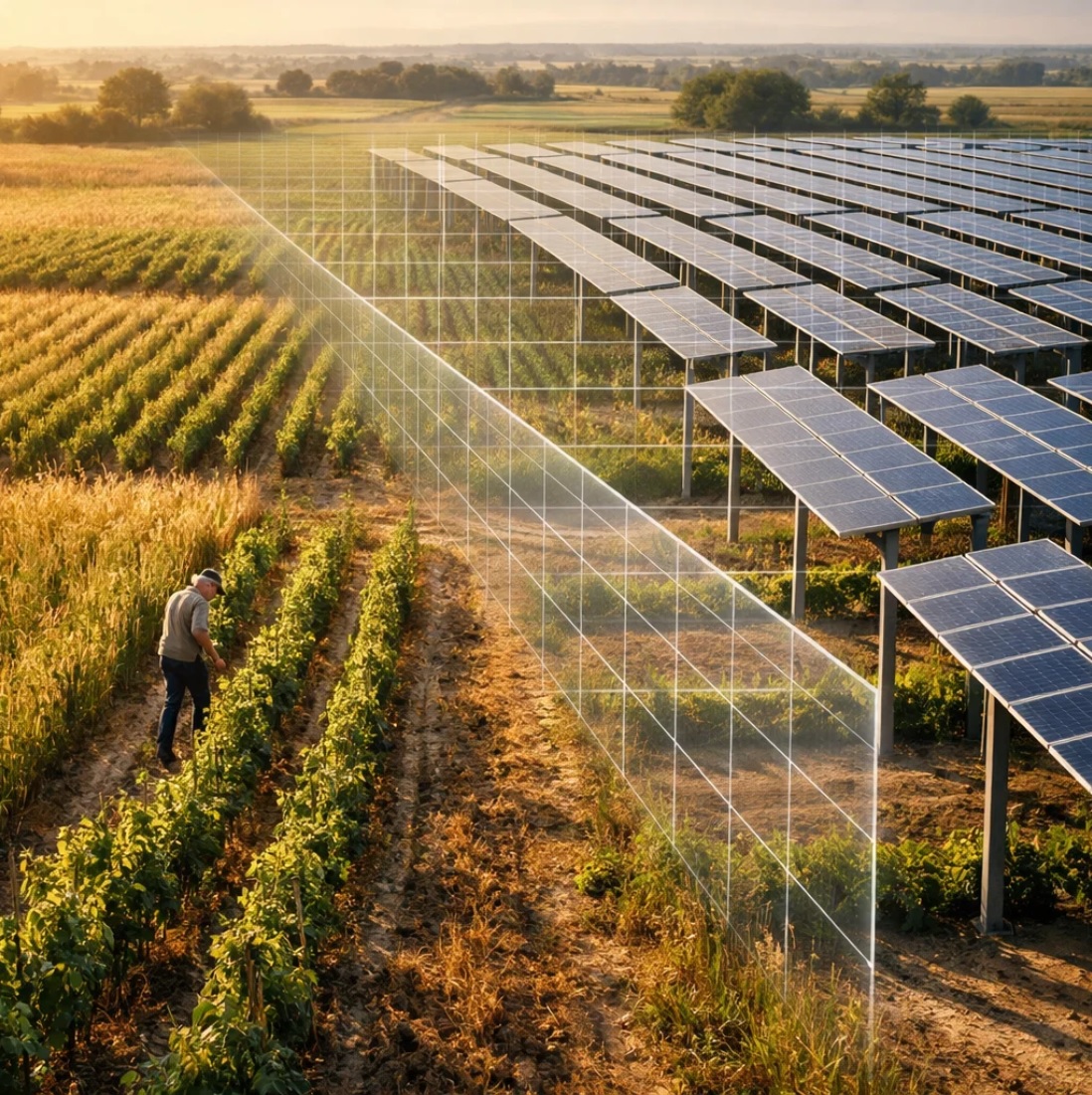
On March 16, 2026, the Conseil d’État issued key decisions confirming the validity of the regulatory framework governing agrivoltaic and agricompatible solar installations in France.
These rulings definitively uphold Decree No. 2024-318 of April 8, 2024, adopted under the Law No. 2023-175 of March 10, 2023 (APER Law).
Key takeaway:
The legal regime applicable to agrivoltaic projects is now fully validated and operational, providing long-awaited regulatory certainty for energy producers and investors.
1. A Confirmed Legal Definition of Agrivoltaic Installations
The Conseil d’État validates the regulatory criteria used to define an agrivoltaic installation, as set out in Article L. 314-36 of the French Energy Code.
Core legal principles confirmed:
- Agrivoltaic systems must provide measurable services to agricultural activity, such as:
- Climate adaptation (e.g., protection against heat or drought)
- Improvement of crop yield conditions
- Enhancement of animal welfare
- The primacy of agricultural activity is a binding legal requirement.
- A minimum agricultural productivity threshold of 90% (compared to a reference yield) is valid for crop-based projects.
- For livestock-related projects, no fixed numerical threshold is required, provided that functional agricultural benefits are demonstrated.
Legal implication
The Conseil d’État confirms that these criteria:
- Do not constitute an error of law
- Do not amount to a manifest error of assessment
👉 This establishes a clear, enforceable qualification test for agrivoltaic projects.
2. The Role of the CDPENAF: Strictly Framed but Not Fully Exhausted
The decisions also clarify the role of the Commission Départementale de Préservation des Espaces Naturels, Agricoles et Forestiers (CDPENAF).
What is confirmed:
- The CDPENAF’s binding opinion is limited to assessing whether a project:
- Compromises the preservation of agricultural, natural, or forest land
- Its role is therefore legally constrained, not discretionary.
What remains unresolved:
- The Conseil d’État does not explicitly rule on whether:
- The CDPENAF may rely on broader considerations outside strict land preservation
👉 This leaves a residual litigation risk, particularly where negative opinions are based on expansive reasoning.
3. Agricompatible Installations and the “10-Year Rule”
The Conseil d’État also validates the provisions relating to agricompatible photovoltaic projects under the French Urban Planning Code (Article R. 111-58).
Key condition confirmed:
- Solar installations on agricultural or natural land are only permitted where:
- The land is unused or uncultivated for at least 10 years
Legal consequence:
- This requirement becomes a critical eligibility condition for:
- Land qualification
- Project structuring
- Administrative approval
👉 Land status is no longer a secondary issue it is a legal prerequisite.
4. A Stabilized Regulatory Framework for Agrivoltaics
Taken together, the March 16, 2026 decisions:
- Reject all legal challenges against the decree
- Confirm the legality of the regulatory framework in its entirety
- Reinforce the consistency of prior case law developments (including earlier rulings on CDPENAF oversight)
Practical outcome for stakeholders
For energy producers, developers, and investors:
- The regulatory framework is now legally secure
- Key technical criteria are validated and enforceable
- Remaining uncertainties are identified and manageable
👉 The transition from legal uncertainty to operational deployment is now complete.
5. Strategic Implications for Energy Projects
What this means in practice
Agrivoltaic project development in France now requires:
- Precise qualification of installations against regulatory criteria
- Robust agronomic modeling to meet the 90% productivity threshold
- Careful land due diligence, particularly regarding the 10-year inactivity rule
- Anticipation of administrative scrutiny, especially from CDPENAF
Risk management perspective
While the framework is validated, legal risk has not disappeared it has shifted:
- From regulatory uncertainty
- To compliance execution and project structuring
Conclusion: Legal Certainty Is Secured Execution Now Becomes the Differentiator
The Conseil d’État’s March 2026 decisions mark the end of a critical phase in the development of agrivoltaics in France.
The legal architecture is now:
- Validated
- Structured
- Predictable
However, this increased legal certainty introduces a new challenge:
👉 Compliance precision becomes the primary driver of project success
In this environment, legal expertise is no longer reactive. It is a structural component of project performance, ensuring that regulatory requirements are integrated from the earliest stages of development.
Organizations that embed legal analysis into project design are better positioned to:
- Avoid delays
- Secure approvals
- Protect capital deployment
Key Legal References
- Conseil d’État, March 16, 2026, No. 494883
- Decree No. 2024-318 of April 8, 2024
- Law No. 2023-175 of March 10, 2023 (APER Law)
- French Energy Code, Article L. 314-36
- French Urban Planning Code, Article R. 111-58
Sources :
https://www.conseil-etat.fr/fr/arianeweb/CE/decision/2026-03-16/494941
https://www.conseil-etat.fr/fr/arianeweb/CE/decision/2026-03-16/494883