Executive Summary:
In French construction law, the applicability of the 10‑year decennial liability regime (“garantie décennale”) to photovoltaic panels installed on existing buildings depends on how the panels function within the structure of the building. Recent jurisprudence, especially the French Supreme Court’s decision on February 19, 2026 (Court of Cassation, 3rd Civ., No. 24‑10.702), clarifies this issue in line with the framework of Articles 1792 and 1792‑7 of the Civil Code.
📍 Background: Decennial Liability in French Construction Law
In France, decennial liability is a cornerstone of construction risk management. Under Article 1792 of the French Civil Code, constructors are automatically liable for major defects that either:
- Compromise the structural integrity of the building, or
- Make the building unfit for its intended use.
This regime carries an insurance obligation to ensure financial protection against such defects for a period of 10 years after project completion.
However, this broad regime is qualified by Article 1792‑7, which specifically excludes certain types of equipment from automatic decennial guarantees when they serve a purely professional function rather than contributing to the structural performance of the building.
📌 The Core Legal Issue: Function Over Form
The pivotal question in recent jurisprudence is not where photovoltaic panels are installed, but what role they play within the built environment.
French courts increasingly emphasize a functional test:
- Do the panels contribute to the structural performance of the building for example, participating in clos, couvert (the building’s envelope and weatherproofing)?
- Or do they simply serve as equipment dedicated to producing electricity?
✔️ When Decennial Liability Applies
Photovoltaic panels may fall within the scope of decennial liability when they are:
- Integrated into the roof in such a way that they become part of the building envelope,
- Replace or functionally replace existing roofing materials, thereby contributing to the clos and couvert of the structure the essential functions that protect the interior of the building from environmental exposure.
In such cases, courts have upheld that defects affecting these panels can fall under Article 1792, as they are part of the overall construction of the building and not merely add‑on equipment.
❌ When Decennial Liability Does Not Apply
Under Article 1792‑7, the decennial guarantee does not extend to elements that are:
- Installed on an existing roof without replacing or taking over essential structural functions,
- Functionally limited to electricity production, and not contributing to the building’s envelope or weatherproofing.
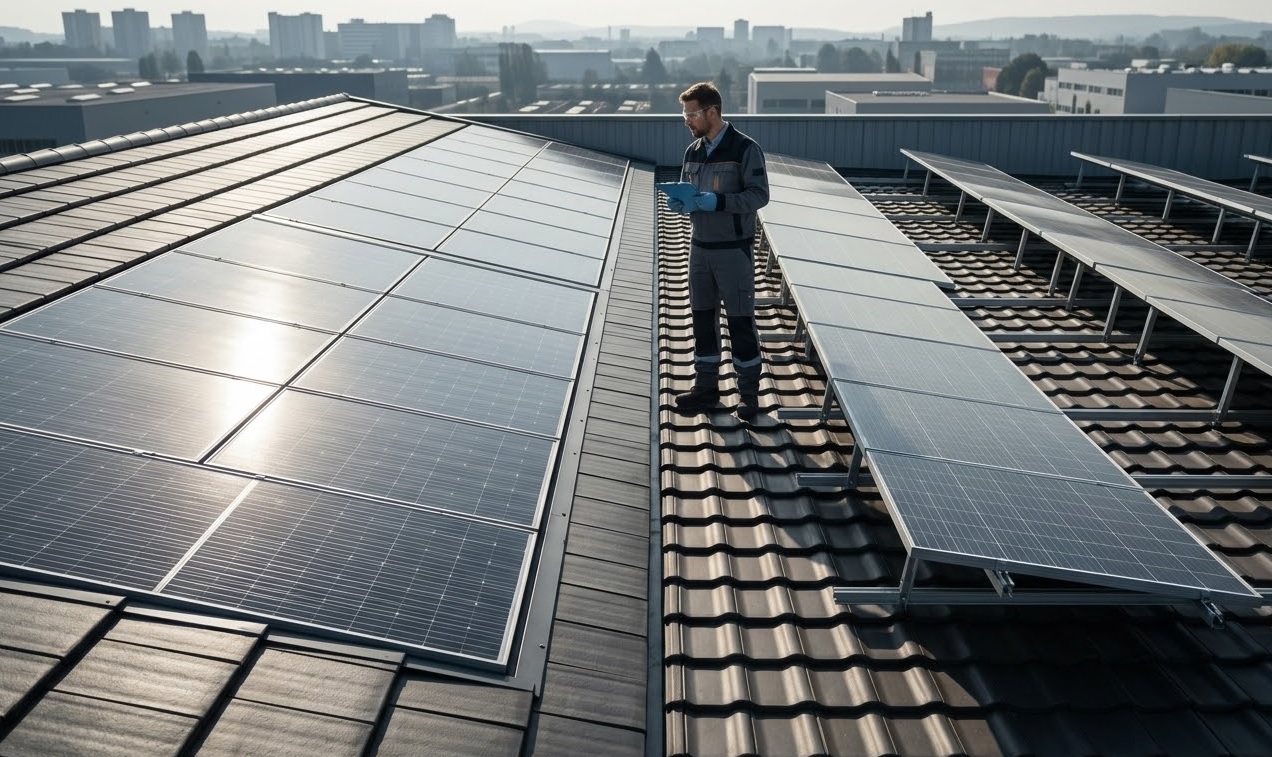
In a February 19, 2026 decision, the French Supreme Court confirmed that where photovoltaic panels are mounted in surimposition (overlay) on an existing roof that already performs the building’s envelope function, they are best characterized as professional equipment.
Accordingly, damages related to such installations are not covered by the decennial guarantee and may instead be subject to ordinary contractual liability, which is generally less protective and not automatically insured.
📊 Why This Matters: Business & Risk Implications
For CEOs and CFOs planning or overseeing solar investments on corporate campuses, industrial buildings, or commercial real estate portfolios, the distinction is not theoretical it is financially material.
- Insurance Coverage: Decennial liability triggers mandatory insurance, which can cover major structural risks. Exclusion means companies must absorb risk or obtain alternative insurance.
- Project Contracts: Understanding whether installations are governed by the decennial regime impacts commercial terms, warranties, and negotiation strategies.
- Asset Valuation & Due Diligence: When panels are not covered by the decennial guarantee, investors and lenders may view the risk profile of the asset differently.
- Litigation Exposure: Ordinary contractual liability typically requires fault and causation to be established delaying recovery and increasing legal costs.
🧠 Practical Framework for Decision‑Makers
To evaluate decennial liability risk on photovoltaic installations:
- Assess the role of the panels: Do they replace or supplement structural elements?
- Review construction documentation: Were panels mounted on an existing roof, or did the installation modify or replace the building envelope?
- Engage legal and technical advisors early: Interdisciplinary analysis can prevent misclassification ex post.
- Align contracts with risk profile: Ensure warranty and insurance frameworks reflect the liability regime that realistically applies.
🔎 Key Takeaways for Corporate Leadership
- Function overrides form: The legal qualification of photovoltaic panels hinges on what they do, not merely where they are attached.
- Decennial liability may not apply to panels mounted on existing roofs that do not contribute to envelope functions.
- Strategic legal planning matters: Early legal insight can protect balance sheets and preserve insurance coverage.
This evolving jurisprudence also underscores the value of integrated legal risk assessment in capital projects not as a cost center, but as a strategic enabler of informed investment decisions.
📣 Conclusion
For companies investing in renewable energy installations, the legal architecture of construction guarantees can materially affect risk exposure and financial outcomes.
Distinguishing between structural elements and professional equipment is more than a semantic exercise it is a governance imperative.
Integrating legal analysis into project design and contract negotiation can safeguard corporate interests decades into the future.
Source : https://www.courdecassation.fr/decision/6997fe49cdc6046d470bef69