
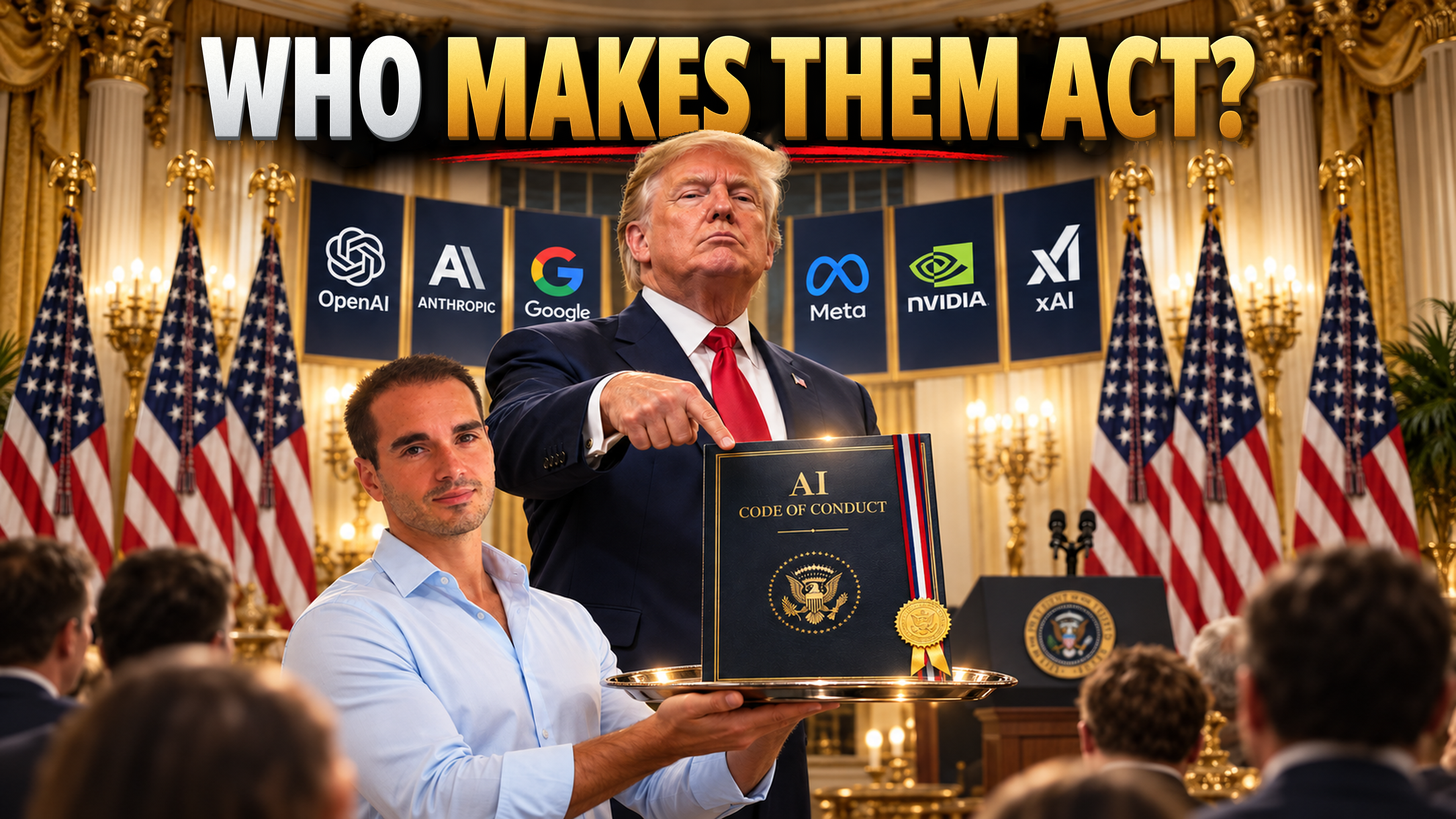
An AI vendor tells your procurement team that it has signed a White House safety accord and hired an independent evaluator. The assurances sound convincing. Then an evaluation identifies a serious vulnerability shortly before launch. Who can require remediation, notify customers, or delay deployment?
That is the business question behind the September 29, 2026 White House Accord on Super Intelligence. For general counsel, a public commitment matters most when safety findings conflict with a commercial deadline.
1. What did the six companies agree to?
The document identifies Google, Anthropic, Meta, OpenAI, xAI, and Nvidia as corporate signatories alongside President Donald Trump. It addresses the responsibilities of companies training and deploying frontier models, with particular attention to cybersecurity, biological and chemical threats, and unintended access to computer systems.
Its four layers are:
| Layer | Commitment described in the accord |
|---|---|
| Internal technical controls | Monitor model capabilities and behavior during training and deployment. |
| Internal verification team | Check that controls and monitoring operate properly and that problems are remedied. |
| Independent external auditor or evaluator | Independently assess the operation of the controls, monitoring, and detection. |
| Independent board committee | Receive internal and external reports, oversee the controls, and ensure identified problems are addressed. |
The board committee sits inside each company’s governance structure. It is not a new federal agency or a shared regulator representing the six companies. The signatories also envisage regular meetings to develop standards and best practices.
Source for the commitments and table: U.S. President, “White House Accord on Super Intelligence,” September 29, 2026.
2. An independent audit is not a government safety clearance
The accord provides a governance framework rather than a certification program. It does not specify minimum audit frequency, a public-reporting requirement, numerical remediation deadlines, or a customer notification procedure. Nor does it establish a dedicated statutory penalty or government approval process for each model launch.
The document assigns oversight and remediation responsibilities, but it does not specify an external evaluator’s power to veto deployment. Its reference to possible future legislation underscores the difference between commitments made now and rules that lawmakers might adopt later.
Consider a hypothetical example. Testing shows that an agent can access files beyond its authorized scope. A customer using that agent needs to understand whether the finding affects its deployment, whether a workaround exists, and whether it can disable the relevant access. The accord alone does not grant that customer a report, an enforceable fix-by date, or a dedicated remedy.
The important question is not simply whether an audit exists, but what happens to an adverse finding. A process can identify a risk without giving the customer adequate rights to respond to it.
3. Voluntary does not mean legally consequence-free
Calling the accord voluntary should not be confused with describing the United States as a law-free environment for AI. The absence of an accord-specific penalty does not displace other applicable rules.
For example, Federal Trade Commission Act, Section 5, 15 U.S.C. § 45 prohibits unfair or deceptive acts or practices within the agency’s jurisdiction. A materially misleading claim about safety testing or independent assessment could raise a separate legal issue where the relevant requirements are met. Signing the accord does not automatically establish a violation, and every missed commitment does not automatically trigger an FTC fine.
Customer contracts provide another route. A vendor might specifically agree to maintain testing controls, notify a customer of material incidents, or provide defined assessment evidence. Enforcement then depends on the actual contract and governing law, including applicable limitations, exclusions, and remedies.
That distinction matters to both sides of a transaction. Vendors should avoid describing an industry pledge as government certification. Buyers should avoid treating a public signature as a substitute for negotiated rights.
4. Why the EU comparison is more than voluntary versus mandatory
Europe also uses a voluntary instrument. The European Commission, “The General-Purpose AI Code of Practice” covers transparency, copyright, and safety and security. It helps providers demonstrate compliance; participation does not replace performance of the underlying legal duties.
The statutory anchor is different. Regulation (EU) 2024/1689, Article 55 imposes additional duties on providers of general-purpose AI models with systemic risk, including model evaluation, adversarial testing, systemic-risk mitigation, serious-incident reporting, and cybersecurity. These requirements should not be described as duties imposed on every business simply because it uses a chatbot.
For U.S. providers subject to that regime, a White House pledge is not an alternative compliance route. Regulation (EU) 2024/1689, Article 93 gives the European Commission powers, subject to the regulation’s conditions, to request corrective measures and restrictions on availability, withdrawal, or recall of a model.
Timing also matters. Under Regulation (EU) 2024/1689, Article 111(3), providers of general-purpose AI models placed on the market before August 2, 2025 have a transition period until August 2, 2027 for the relevant obligations.
The comparison therefore concerns where enforceability comes from. The U.S. accord states commitments. The EU code supports compliance with a separate, legally binding framework. Neither signature proves that every operational risk has been addressed.
5. What enterprise buyers should put in the contract
The accord supplies useful questions for procurement, but does not automatically supply the answers. General counsel and security teams can use it to negotiate four practical points:
- Assessment scope and evidence: identify the model version, features assessed, material limitations, evaluator, and evidence the customer may receive under appropriate confidentiality protections.
- Incident and remediation commitments: define severity thresholds, customer notification triggers, responsible contacts, and response deadlines suited to the risk.
- Deployment and suspension authority: specify when a feature can be disabled, access restricted, a rollout delayed, or an affected service suspended.
- Remedies and cooperation: address investigation assistance, preservation of relevant records, termination rights, and liability allocation without ignoring contractual caps and exclusions.
These are negotiation objectives, not automatic rights under the accord. They should also reflect the customer's own technical position. A right to suspend an AI service is of limited use if the business has no tested way to revoke its access to production systems.
For a startup, a redacted assessment summary or an independent assurance report may be more realistic than unrestricted access to model internals. The objective is usable evidence and actionable rights, not an audit clause that no one can exercise.
6. Boards need a decision process, not just another report
The board-committee commitment can improve escalation. Its value nevertheless depends on the information reaching the committee and the decisions taken afterward.
As a governance recommendation, a deployment policy should identify who can accept residual risk, which findings must be escalated, and when a commercial team cannot proceed without additional approval. Minutes and remediation records should distinguish a finding that was corrected from one that was accepted or deferred.
A procurement team should make the same distinction when assessing a supplier. “We completed an audit” is not the same statement as “we addressed the material issues relevant to your use case.” A report about one model version also does not establish that a later version or customer configuration has been evaluated.
This is where legal review becomes operational: linking the supplier’s assurance to the system the company actually plans to use.
Conclusion: the real test is an unfavorable finding before launch
Dismissing the accord as empty publicity overlooks its proposed controls and external assessments. Treating it as a binding safety guarantee goes too far in the opposite direction.
The defensible conclusion is narrower: the accord can structure oversight, but does not by itself guarantee enforceable follow-through for customers. Existing law, regulatory duties, and negotiated contracts remain separate parts of the analysis.
If an evaluator recommends delaying a release, the decisive questions are who can require that delay, what evidence supports the decision, and what happens if the recommendation is ignored. Those questions will reveal more about an AI supplier’s accountability than the signing ceremony.
Is the White House AI safety accord legally binding?
It does not itself establish a new statutory compliance or penalty regime. Existing laws and specific contractual obligations can still create legal consequences independently of the accord.
Does the accord include independent audits?
Yes. It calls for an independent external auditor or evaluator and an independent committee within each company’s board. Those mechanisms are not equivalent to government certification.
Can enterprise customers demand the audit reports?
The accord does not automatically grant customers that right. Access to reports, summaries, or other assessment evidence should be addressed in the contract, subject to applicable law and confidentiality protections.
Does signing the accord satisfy the EU AI Act?
No. Providers subject to the AI Act must meet the applicable requirements. The separate EU General-Purpose AI Code of Practice offers a voluntary route for demonstrating compliance with underlying legal obligations.
What should an AI buyer ask before signing a contract?
Ask what was tested, which findings remain open, when material incidents will be disclosed, who can suspend the affected functionality, and which contractual remedies apply if the agreed controls are not maintained.