
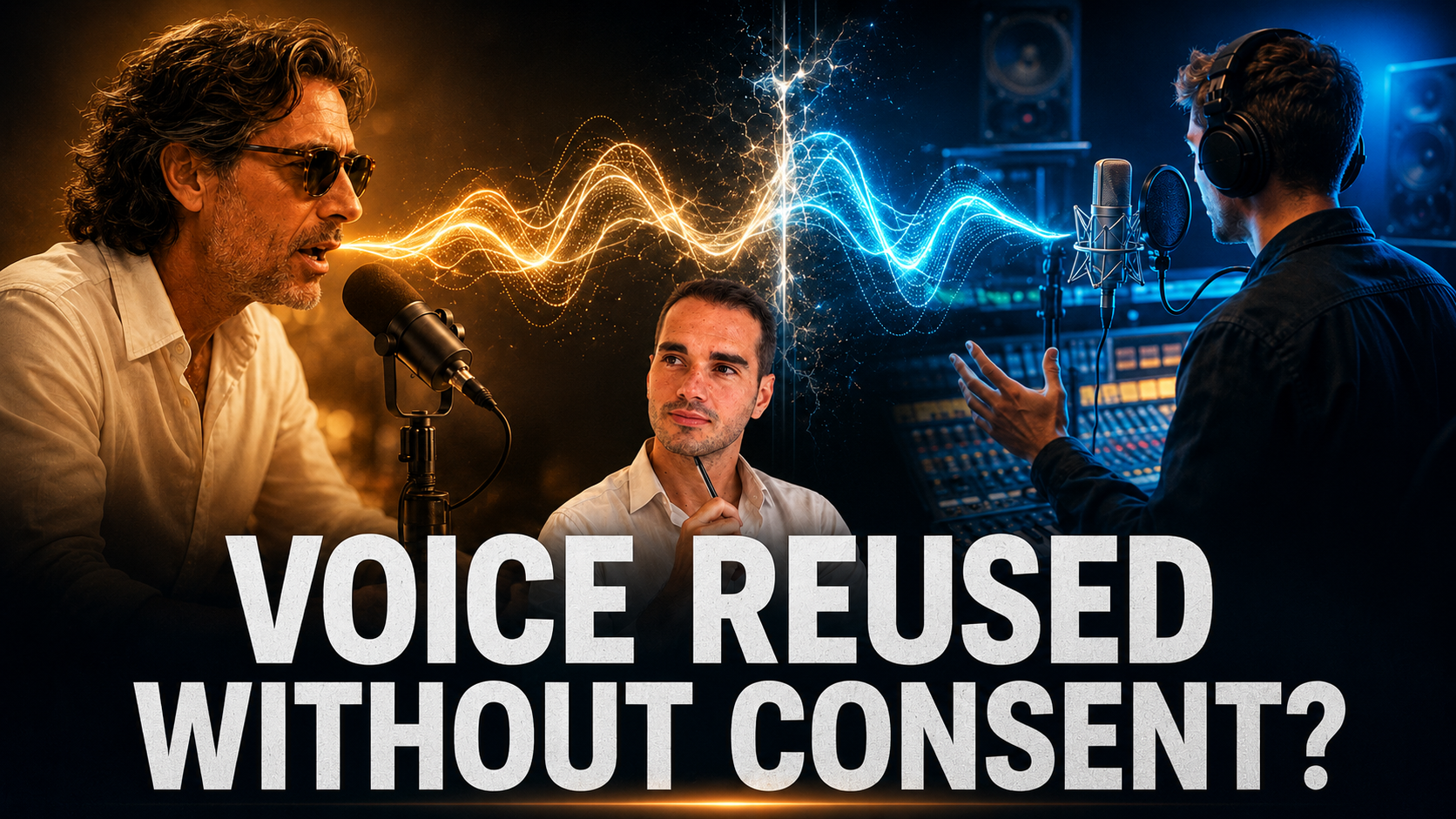
A person’s voice is therefore protected under Article 9 of the French Civil Code and Article 8 of the European Convention on Human Rights.
However, that protection is not absolute.
When the use of a voice is part of artistic expression, French courts must balance personality rights against freedom of expression under Article 10 of the European Convention.
For U.S. readers, the closest conceptual comparison may be a right-of-publicity or voice-misappropriation claim, but French law approaches the issue differently: the protection recognized in this case is fundamentally a personality and privacy right, not simply an intellectual-property right.
A Public Controversy Becomes a Voice-Rights Case
The dispute began in April 2021.
French music journalist Fabien Lecœuvre made controversial public comments about the physical appearance of several recording artists, including singer Hoshi.
The comments generated widespread criticism.
A few months later, French artist Grand Corps Malade responded through music.
His song Des Gens beaux incorporated excerpts from Lecœuvre’s original interview, using the journalist’s actual voice without authorization.
The excerpts represented 33 seconds of a 161-second song.
Lecœuvre sued the producer, Anouche Productions, and Universal Music France, seeking damages and removal of his voice from future exploitation of the recording and music video.
The Paris Court of Appeal Sided With the Journalist
The Paris Court of Appeal found that the unauthorized use of Lecœuvre’s voice infringed his voice rights.
It awarded €10,000 in moral damages and ordered the defendants to remove the voice excerpts from future uses of the song and video.
That reasoning appeared straightforward:
the voice was identifiable, it was used without authorization, and the individual had a right to control its use.
The producers appealed.
The Defense: Artistic Freedom
The producers argued that the case could not be analyzed through personality rights alone.
The original statements had been intentionally made in public.
They had triggered a significant public controversy.
The excerpts had not been materially distorted.
Their use served an artistic response to the original statements.
The defendants therefore relied on freedom of artistic expression protected by Article 10 of the European Convention on Human Rights.
Universal Music raised an additional issue.
Could Article 9 of the French Civil Code, which protects private life, apply to a voice taken from statements that the individual had voluntarily made in public?
The Cour de cassation answered yes.
A Person’s Voice Is an Attribute of Personality
The June 24, 2026 ruling first establishes the central legal principle.
French case law already recognizes that a person has legal control over the capture, retention, reproduction, and use of their image.
The Cour de cassation extended that reasoning to the human voice.
It held that:
Like a person’s image, a person’s voice is one of the principal attributes of personality.
The right to respect for private life under Article 9 of the French Civil Code and Article 8 of the European Convention therefore includes protection of an individual’s voice.
Importantly, public exposure does not automatically eliminate that protection.
A voice does not become freely reusable merely because it was previously broadcast publicly.
Yet the Cour de cassation still overturned part of the lower court’s judgment.
Voice Rights and Artistic Freedom Have Equal Normative Value
This is the most important part of the ruling.
The right to private life and personality protection does not automatically override freedom of expression.
Nor does artistic freedom automatically override the individual’s voice rights.
The two rights have equal normative value.
French courts must therefore balance them and, where necessary, select the outcome that best protects the more legitimate interest in the specific circumstances.
The Cour de cassation relied on the European Court of Human Rights’ framework in Couderc and Hachette Filipacchi Associés v. France.
Relevant factors include:
- whether the expression contributes to a debate of general interest;
- the public profile of the person concerned;
- the subject matter;
- the individual’s prior conduct;
- the content and form of the publication or work;
- its consequences;
- and the circumstances surrounding the disputed use.
This is not a categorical consent rule.
It is a proportionality analysis.
Why the Lower Court’s Analysis Was Incomplete
The Paris Court of Appeal had concluded that the song did not contribute to a debate of general interest.
The Cour de cassation disagreed with that reasoning.
The lower court had itself found that the original statements triggered strong public controversy.
The statements also concerned the role of physical appearance in professional success in the music industry.
The Supreme Court considered both factors sufficient to establish a debate of general interest.
The lower court therefore could not simply find an infringement of voice rights and stop there.
It also had to determine whether artistic freedom justified the use after balancing the competing rights.
The case was sent back to a differently composed panel of the Paris Court of Appeal.
Voice Rights Are Not Copyright
The decision is also important because it separates voice rights from intellectual-property rights.
The claimant’s copyright and neighboring-right arguments had been rejected, and that part of the lower court judgment remained intact.
The protection recognized by the Cour de cassation was therefore not based on ownership of the sound recording or a copyright in the voice.
It was based on the voice as an attribute of the individual.
For U.S. companies, this distinction matters.
Obtaining copyright or licensing rights in an audio asset does not necessarily resolve every issue related to the human identity embodied by the voice.
Why This Matters for U.S. Companies Operating in France
The decision is relevant far beyond music.
Companies increasingly use human voices in:
- advertising campaigns;
- branded videos;
- podcasts;
- e-learning products;
- AI assistants;
- digital avatars;
- customer-service tools;
- synthetic media;
- and generative AI systems.
For businesses, the legal review should therefore address more than ownership of the underlying recording.
Companies should ask whether the authorization covers:
- recording;
- reproduction;
- editing;
- reuse;
- commercial exploitation;
- transformation;
- synthetic generation;
- voice cloning;
- sublicensing;
- and AI-based use.
The scope of the permission may become as important as the permission itself.
What About AI Voice Cloning?
The June 24, 2026 ruling did not involve an AI-generated clone and does not resolve every legal issue associated with synthetic speech.
It nevertheless creates an important legal foundation.
If an individual’s voice is itself a protected attribute of personality, generating a recognizable artificial replica can raise personality-rights questions even where no original sound recording is directly reused.
That issue is distinct from copyright.
A company may have permission to use a recording while lacking sufficiently broad authorization to create a synthetic version of the speaker’s identity.
For AI governance, the distinction is increasingly important:
rights in content and rights in the person represented by that content are not the same thing.
Practical Takeaways for Companies
Before using an identifiable human voice in France, companies should review:
- Who owns the recording?
- What personality-right authorization was obtained from the speaker?
- What uses were expressly permitted?
- Does the authorization cover editing or transformation?
- Does it cover AI training, synthetic generation, or voice cloning?
- Is the use commercial, artistic, informational, or part of a public-interest debate?
- Could freedom of expression justify the use even without consent?
This analysis should take place before publication.
Is a person’s voice legally protected in France?
Yes. Since the June 24, 2026 ruling, the Cour de cassation expressly recognizes the voice as one of the principal attributes of personality.
Can a publicly recorded voice be reused without consent?
Not automatically.
Public exposure does not eliminate voice protection. However, an unauthorized use may still be lawful in certain circumstances where freedom of expression or artistic freedom is the more legitimate interest after a proportionality analysis.
Is a person’s voice protected by copyright?
Not simply because it is their voice.
The 2026 case confirms that voice protection can arise from personality and privacy rights independently of copyright or neighboring rights.
Does artistic freedom always justify using a voice?
No.
Courts must balance artistic freedom against personality rights based on the circumstances of the case.
Does the ruling prohibit AI voice cloning?
The ruling does not directly decide AI voice-cloning cases.
However, recognizing the voice as an attribute of personality makes the decision highly relevant to future disputes involving synthetic and cloned voices.
Conclusion
The June 24, 2026 ruling does not create an absolute ownership right over every use of a human voice.
Instead, it establishes a more nuanced rule.
A voice is part of the person.
Its use can therefore implicate personality rights even where the underlying words were spoken publicly and even where copyright does not provide the relevant protection.
At the same time, artistic and expressive freedoms remain equally protected.
For companies working with media and AI, the practical lesson is straightforward: