
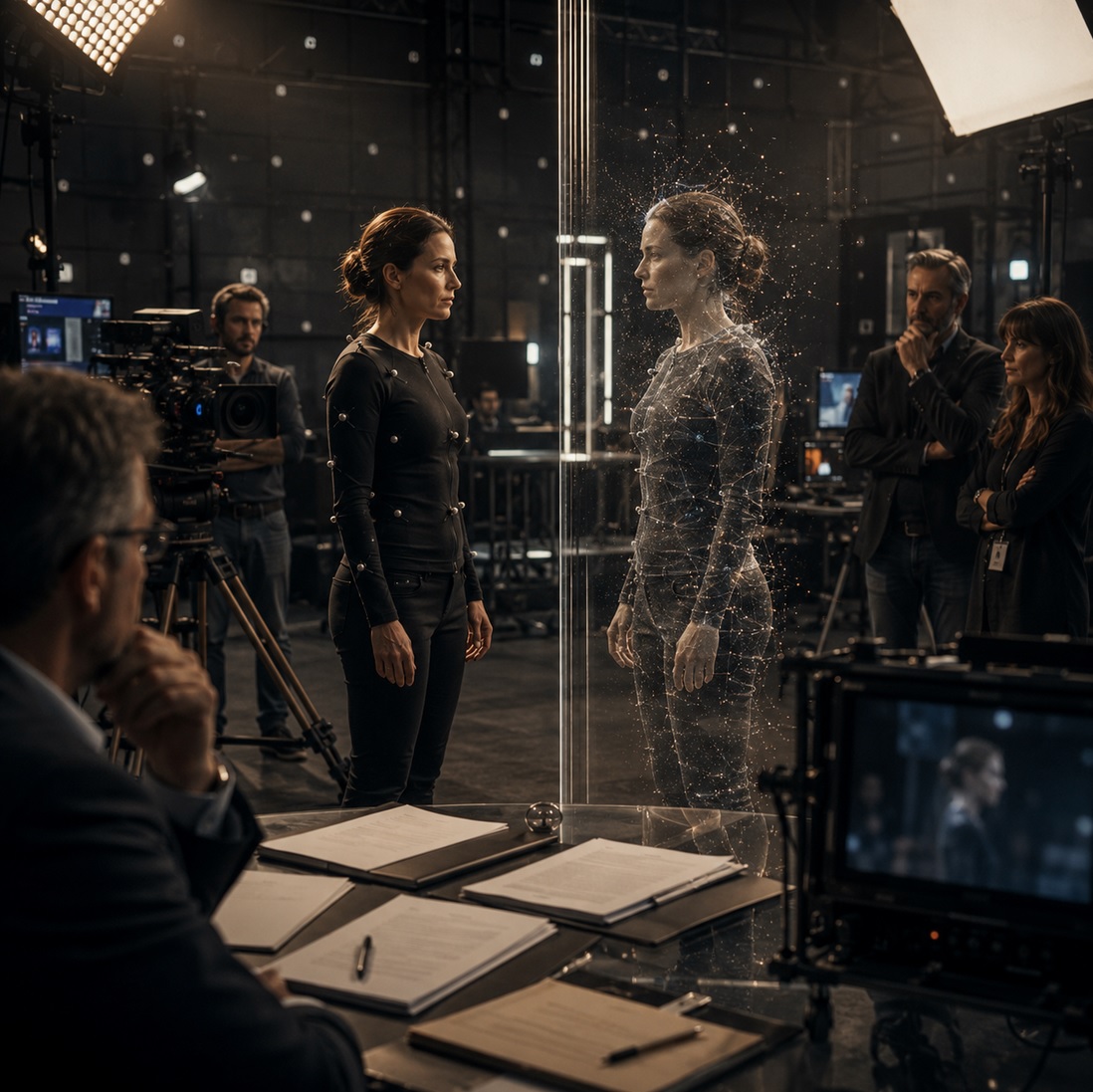
Executive Summary
Hollywood’s new agreement on the use of artificial intelligence in film and television does not ban AI from creative production.
It does something more legally significant.
It begins to define when AI can reproduce a human performer, under what conditions, with whose consent, and against what compensation.
This agreement matters far beyond Hollywood.
It provides one of the first large-scale contractual models for governing digital replicas, synthetic performers, AI-generated voices, AI-generated likenesses, and synthetic performances.
For European companies, the main lesson is clear: the future of AI in creative, advertising, gaming, media, and brand content will not be governed only by technology. It will be governed by consent, contract, traceability, transparency, and proof.
In France and the European Union, the legal framework already contains several powerful tools to address these risks: personality rights, image rights, performers’ neighboring rights, the GDPR, intellectual property law, contract law, and the EU AI Act.
The real question is no longer whether companies may use AI-generated voices, faces, avatars, or performances.
The question is whether they can prove that each use was authorized, limited, documented, and fairly compensated.
Key Takeaways
Hollywood’s AI agreement marks a turning point because it treats human identity as a legally controlled asset, not as raw material for generative AI.
The distinction between a “digital replica” and a “synthetic performer” is central. A digital replica refers to the AI-based reproduction of a real, identifiable performer. A synthetic performer refers to an AI-generated character not directly tied to a specific real person.
For digital replicas, the legal baseline is consent and compensation.
For synthetic performers, the regime is more flexible, but the risk remains high if the synthetic character resembles, evokes, or substitutes a real identifiable person.
Under French law, the use of a person’s image, voice, likeness, or performance may trigger personality rights, image rights, performers’ rights, contract law, data protection law, and evidentiary requirements.
Under EU law, the GDPR may apply when AI systems process personal data relating to an identified or identifiable natural person. The AI Act also introduces transparency obligations for certain AI-generated or manipulated content.
The biggest practical risk for companies is not only unauthorized AI use. It is relying on old, vague, or overly broad contracts that were never drafted for generative AI.
Quick Answer: What Does Hollywood’s AI Agreement Teach Companies?
Hollywood’s AI agreement shows that generative AI can be used in creative industries, but not as a legal shortcut around human consent.
The core lesson is simple: when AI reproduces a person’s face, voice, body, performance, or recognizable identity, companies should treat the use as a rights-sensitive operation.
That means obtaining clear authorization, defining the permitted uses, documenting the scope of consent, setting compensation terms, and preserving evidence of what was agreed.
For French and European companies, this approach is not optional best practice. It reflects the direction already taken by personality rights, neighboring rights, GDPR compliance, AI transparency rules, and modern contract governance.
1. Why Hollywood’s AI Agreement Matters
The Hollywood agreement is important because it moves the debate beyond the simplistic question of whether AI should be allowed in cinema.
The agreement does not say that AI has no place in film production.
It recognizes that AI can assist creative work, support production workflows, enable dubbing, create visual effects, and generate new forms of content.
The legal issue begins when AI is used not merely as a tool, but as a substitute for human identity or human performance.
A face is not just a visual asset.
A voice is not just an audio sample.
A performance is not just a dataset.
For performers, these elements are economic assets, personal attributes, creative expressions, and professional identity.
This is why the agreement matters.
It suggests that the central legal category of the generative AI era may not be “content” alone. It may be “replication.”
2. The Birth of Digital Replication Law
Digital replication law can be understood as the emerging legal field governing the AI-based reproduction, simulation, transformation, or extension of a person’s identity or performance.
It includes questions such as:
Can a studio recreate an actor’s face after filming?
Can a brand clone a model’s voice for future campaigns?
Can a video game publisher generate new dialogue from a previous voice recording?
Can a company create an avatar inspired by a real employee, artist, influencer, or performer?
Can a deceased actor be recreated with the consent of heirs?
Can old contracts authorize future AI uses that did not exist at the time of signature?
These questions are no longer theoretical.
They now affect film, music, advertising, video games, fashion, corporate communication, training videos, customer service avatars, synthetic influencers, and virtual assistants.
The Hollywood agreement is one of the first major contractual attempts to draw boundaries around these practices.
Its importance lies in the legal architecture it proposes: distinguish the reproduction of a real person from the creation of a synthetic character.
3. Digital Replicas vs Synthetic Performers
What is a digital replica?
A digital replica is an AI-generated or digitally generated reproduction of a real performer’s voice, likeness, appearance, movement, or performance.
The key element is identification.
If the audience, producer, or contracting party can connect the generated output to a specific real person, the legal risk increases significantly.
Examples may include:
A digital version of an actor’s face used in a new scene.
A voice clone used to generate new dialogue.
A body scan used to create new movements.
A performer’s past recordings used to generate new material.
A deceased actor recreated for a new project.
In these cases, the legal question is not only whether the output is realistic.
The question is whether it reproduces, extends, or substitutes a real person.
What is a synthetic performer?
A synthetic performer is an AI-generated character that is not directly based on a specific real person.
In principle, this category is more flexible because it does not require consent from a particular identifiable individual.
However, the line is not always clear.
A synthetic performer may still create legal risk if it is designed to resemble a real actor, imitate a recognizable voice, evoke a specific performer’s style, or replace a human role in a way that has contractual or collective bargaining consequences.
The central distinction remains identification.
If the synthetic output can be linked to a real person, the legal analysis changes.
4. The Core Legal Principle: Identification Triggers Protection
The central legal principle emerging from the Hollywood agreement is that identification triggers legal protection.
This principle is highly relevant for French and European law.
When AI creates a generic fictional character, the legal analysis may focus mainly on intellectual property, contractual allocation, and labeling obligations.
When AI reproduces a recognizable human identity, additional layers arise:
personality rights,
image rights,
voice rights,
performers’ rights,
data protection,
moral rights,
contractual consent,
and remuneration.
This is why identification is the decisive legal threshold.
Generative AI creates scale, speed, and realism.
Law responds by asking a more basic question:
Who is being reproduced?
5. Why Consent Becomes the First Line of Defense
Consent is the first legal safeguard in AI-based digital replication.
In the Hollywood agreement, digital replicas require prior authorization and compensation.
That structure is highly relevant for European companies because it mirrors a broader legal intuition: identity cannot be silently converted into a reusable AI asset.
In practice, consent must be specific.
A general authorization to film, photograph, record, or broadcast a performance may not be enough to authorize future AI-generated uses.
For example, a contract signed for a video shoot may not automatically authorize:
voice cloning,
face replacement,
AI dubbing,
synthetic performance generation,
avatar creation,
future advertising reuse,
training of AI models,
or posthumous exploitation.
This is one of the biggest risks for companies.
Many existing contracts were drafted for traditional media exploitation. They were not drafted for AI systems capable of generating new outputs indefinitely.
6. Why Compensation Must Be Reconsidered
AI changes the economics of performance.
Traditionally, compensation was tied to a recording, a shoot, a role, a performance, or an exploitation period.
Generative AI allows the same initial performance, scan, image, or voice recording to generate new material later.
This creates a compensation problem.
If AI extends the economic life of a performance, the performer may argue that additional compensation is required.
This is especially true when AI is used to generate new scenes, new dialogue, new languages, new formats, new territories, or new commercial campaigns.
For companies, the lesson is clear: compensation clauses should not be limited to initial capture.
They should address future uses, derivative uses, AI-generated extensions, reuse of training data, and commercially distinct outputs.
7. French Law: Why the Hollywood Model Resonates Strongly in France
French law is particularly sensitive to the protection of the person.
This makes the Hollywood agreement especially relevant for French legal teams.
In France, the legal analysis of AI-generated replicas may involve at least five overlapping frameworks:
the right to privacy and image rights,
performers’ neighboring rights,
moral rights,
contract law,
and data protection law.
Each framework may apply depending on the facts.
The challenge is that these rights do not always operate in the same way.
Some rights may be economic.
Some may be personal.
Some may be contractual.
Some may be linked to data processing.
Some may be difficult or impossible to waive broadly.
This means that AI replication projects require a layered legal analysis.
8. Image Rights and Personality Rights Under French Law
In French law, image rights are commonly linked to the broader protection of privacy and personality.
The use of a person’s image generally requires authorization when the person is identifiable and the use is not justified by another legal basis, such as legitimate public information in specific contexts.
For AI-generated content, the issue becomes more complex.
A company may not use the original photograph or video of a person.
It may generate a new synthetic image.
The legal question then becomes: does the generated image reproduce or evoke an identifiable individual?
If the answer is yes, the absence of original footage may not eliminate the legal risk.
Generative AI may therefore force courts and lawyers to focus less on the source file and more on the recognizable result.
This is a major shift.
The relevant question is no longer only “What content did you use?”
It is also “Whose identity did you recreate?”
9. Performers’ Rights Under French Intellectual Property Law
French intellectual property law provides specific protection for performers.
An artist-performer has rights over the fixation, reproduction, and communication to the public of their performance.
This matters directly for AI.
If an AI system reproduces, extends, transforms, or generates new outputs from a recorded performance, the legal analysis may implicate performers’ rights.
The issue is particularly sensitive for:
actors,
voice actors,
dancers,
musicians,
motion-capture artists,
stunt performers,
and dubbing performers.
The law does not only protect the final audiovisual work.
It also protects the performer’s contribution.
This is why AI-generated extensions of a performance cannot be treated as ordinary technical edits without legal review.
The more the AI output resembles a continuation of the performer’s contribution, the stronger the need for authorization, documentation, and contractual clarity.
10. Moral Rights and Integrity of the Performance
French law also recognizes the performer’s right to respect for their name, capacity, and interpretation.
This is important because AI may not simply reuse a performance.
It may alter its meaning.
A performer’s voice could be used in a political message.
A face could be inserted into a scene the performer would never have accepted.
A performance could be modified to express emotions, words, gestures, or contexts that never occurred.
This creates a risk beyond economics.
It affects reputation, dignity, artistic integrity, and professional identity.
For this reason, contracts should not only ask whether AI use is allowed.
They should also define what types of AI use are prohibited.
Examples include:
political uses,
pornographic or sexualized uses,
violent or hateful content,
misleading endorsements,
medical or financial claims,
uses damaging to reputation,
and uses outside the original artistic context.
AI replication clauses should therefore contain both permissions and restrictions.
11. GDPR: When Voice, Face, and Biometric Features Become Personal Data
The GDPR may apply when AI systems process data relating to an identified or identifiable natural person.
A person’s image, voice, appearance, movement, and biometric features may qualify as personal data when they identify or help identify the person.
In some cases, biometric data may be involved, especially where the data results from specific technical processing and allows or confirms unique identification.
This matters for AI replication projects because companies may process:
facial images,
voice recordings,
body scans,
motion-capture data,
performance datasets,
metadata,
and training materials linked to a real person.
If personal data is processed, the company must consider GDPR principles such as:
lawfulness,
transparency,
purpose limitation,
data minimization,
retention limitation,
security,
accountability,
and rights of the data subject.
Consent under contract and consent under the GDPR are not always the same thing.
A performer may contractually authorize certain exploitation rights, but the data controller may still need to identify a lawful basis for processing personal data and comply with GDPR transparency requirements.
This distinction is critical.
12. The EU AI Act: Transparency for Synthetic and Manipulated Content
The EU AI Act adds another layer to the governance of AI-generated content.
Its transparency obligations address certain AI-generated or manipulated outputs, including deepfake-related scenarios.
The purpose is not to ban synthetic content.
The purpose is to prevent deception and preserve trust where people may wrongly believe that artificial content is authentic.
For creative industries, this is highly relevant.
AI-generated faces, voices, performances, and audiovisual scenes may require clear disclosure depending on the context, the nature of the content, and the applicable exceptions.
This means that legal teams must think not only about whether AI content may be created.
They must also consider whether audiences, users, contracting parties, performers, or regulators must be informed that AI was used.
Transparency becomes part of the legal architecture of creative AI.
13. Contract Law: The Weakness of Old Clauses
The biggest immediate risk for companies is contractual.
Many contracts contain broad language such as:
all media,
all formats,
all territories,
all current and future technologies,
perpetual exploitation,
unlimited adaptation,
or full assignment of image rights.
Those clauses may appear protective.
In the AI context, they may be insufficient.
Generative AI creates uses that are fundamentally different from traditional exploitation.
A clause allowing the use of a recorded performance in a film is not necessarily the same as a clause allowing the use of that performance to generate new scenes in future productions.
A clause authorizing a voice recording for one advertising campaign is not necessarily the same as a clause authorizing indefinite voice cloning.
A clause allowing post-production editing is not necessarily the same as a clause allowing synthetic replacement of the performer.
The more transformative the AI use, the more precise the contract should be.
14. Evidence: The Hidden Compliance Issue
Consent is only useful if it can be proven.
This is one of the most important operational lessons of the Hollywood agreement.
Companies must be able to prove:
who consented,
when consent was given,
what was authorized,
for which project,
for which duration,
for which territories,
for which media,
for which AI systems,
for which types of outputs,
under which compensation terms,
and with what restrictions.
In AI projects, evidence should be preserved from the start.
This includes contracts, consents, technical documentation, source files, model-use records, version history, vendor commitments, and approval workflows.
If a dispute arises, the company will not only need to say that it had consent.
It will need to demonstrate the exact scope of that consent.
15. Why This Goes Far Beyond Hollywood
The same legal issues will arise in many sectors.
Advertising
Brands may use AI-generated models, synthetic voices, or digital ambassadors. They must ensure that no real person’s identity is replicated without authorization and that contracts cover AI reuse.
Video Games
Game publishers already rely on motion capture, voice acting, facial animation, and avatar systems. AI can extend or replace performances, creating significant consent and compensation questions.
Corporate Communication
Companies may use AI avatars for training, onboarding, customer support, investor relations, or internal communication. If the avatar is based on an employee, executive, actor, or contractor, legal authorization is essential.
Influencer Marketing
Synthetic influencers and AI-generated brand ambassadors may imitate the aesthetics, style, or identity of real creators. This may raise personality rights, unfair competition, and consumer transparency issues.
Education and Training
AI-generated instructors or voice clones may reproduce identifiable teachers, trainers, experts, or speakers. Consent and contractual scope will become central.
Music and Dubbing
Voice cloning and AI dubbing create direct risks for singers, voice actors, narrators, and dubbing performers. Consent, compensation, and integrity of performance are essential.
Hollywood is only the most visible example.
The legal issue is universal.
16. Assistance vs Replacement: The New Legal Boundary
One of the most useful distinctions from the Hollywood debate is the boundary between AI assistance and AI replacement.
AI assistance may include:
editing support,
visual effects,
minor corrections,
translation support,
dubbing assistance,
workflow optimization,
or technical enhancement.
AI replacement begins when the system substitutes for a human performer’s identity, voice, likeness, or performance.
This distinction will be central to future contracts.
A company may be allowed to use AI to clean audio.
That does not mean it may generate new dialogue.
A studio may be allowed to de-age an actor for a specific scene.
That does not mean it may create an entire new performance without additional consent.
A brand may be allowed to use a model’s photographs for a campaign.
That does not mean it may create a permanent AI model based on that person.
The legal boundary is not “AI or no AI.”
The legal boundary is the scope of human substitution.
17. What Companies Should Put in AI Replication Clauses
Companies using AI-generated voices, likenesses, avatars, or performances should consider specific contractual clauses.
These clauses should address:
the definition of AI use,
the distinction between editing and generation,
authorized inputs,
authorized outputs,
purpose of use,
duration,
territory,
media,
exclusivity,
compensation,
future reuse,
training data use,
fine-tuning,
synthetic extensions,
posthumous use,
right of approval,
right of audit,
technical security,
data retention,
destruction obligations,
prohibited uses,
labeling obligations,
and dispute resolution.
The key is precision.
A clause that simply says “the performer authorizes the use of their image in all media” may no longer be enough.
AI requires granular authorization.
18. What Legal Departments Should Do Now
Legal teams should not wait for litigation to structure their AI replication policies.
They should conduct a practical review of all contracts involving:
actors,
models,
influencers,
voice artists,
employees,
executives,
trainers,
speakers,
creators,
photographers,
video producers,
agencies,
and AI vendors.
They should identify whether existing agreements address:
voice cloning,
digital replicas,
synthetic characters,
AI dubbing,
AI-generated advertising,
avatar creation,
model training,
biometric data,
deepfake disclosure,
and future derivative uses.
If these topics are absent, the contract may be outdated.
The risk is not only legal invalidity.
The risk is losing control over future exploitation, compensation claims, reputational harm, regulatory scrutiny, and disputes with talent.
19. The Governance Lesson: AI Makes Consent More Precise
The central lesson of the Hollywood agreement is not that AI is forbidden.
It is that AI makes consent more precise.
In the pre-AI world, a performer could authorize a recording, a broadcast, a campaign, or a performance.
In the AI world, that same initial recording can become the basis for indefinite generation.
This changes the meaning of consent.
Consent must now answer questions that did not exist before:
Can the data be used to train a model?
Can the model generate new performances?
Can the output be used in future productions?
Can the voice be modified?
Can the face be aged, de-aged, or altered?
Can the performance be translated into other languages?
Can the digital replica be used after death?
Can the performer withdraw or limit future use?
Can the company sublicense the AI-generated replica?
These questions should not be left implicit.
20. Why Collective Agreements May Become a Model for AI Governance
The Hollywood agreement also shows the importance of collective bargaining.
AI regulation will not come only from statutes and courts.
In many sectors, it will emerge through:
collective agreements,
industry standards,
professional codes,
model clauses,
certification frameworks,
insurance requirements,
and procurement policies.
This is especially relevant for creative and intellectual professions.
Legislation often moves slowly.
AI deployment moves quickly.
Collective agreements can fill the gap by defining operational rules before courts and regulators have fully settled the law.
For European companies, this suggests a practical strategy: do not wait for perfect regulation.
Develop sector-specific AI governance rules now.
21. The European Direction of Travel
The European legal direction is increasingly clear.
AI is not treated as a legal vacuum.
When AI affects people, identity, reputation, work, creation, data, or public trust, existing legal frameworks apply.
The GDPR applies where personal data is processed.
Personality rights apply where identity is used.
Performers’ rights apply where artistic performances are fixed, reproduced, communicated, or transformed.
Contract law applies where rights are licensed or transferred.
The AI Act applies transparency and governance obligations in specific AI-related scenarios.
Together, these frameworks point toward the same principle:
AI-generated content is not legally neutral simply because it was generated by a machine.
Human rights, economic rights, and contractual limits remain relevant.
22. Final Analysis: Digital Identity Is Becoming a Compliance Asset
The Hollywood agreement should not be read only as an entertainment industry compromise.
It is a warning to every company using generative AI.
Digital identity is becoming a compliance asset.
Voices, faces, bodies, gestures, expressions, and performances can now be captured, modeled, extended, and reused at scale.
That creates new creative possibilities.
It also creates legal risk.
The companies that manage this well will not be those that simply adopt the most advanced AI tools.
They will be the companies that can prove:
where the data came from,
whose identity was used,
what consent was obtained,
what the contract allowed,
what the AI system generated,
who approved the output,
and what limits were respected.
This is the real meaning of the Hollywood agreement.
It does not mark the end of AI in cinema.
It marks the beginning of a more mature legal architecture for AI-generated identity.
What is digital replication law?
Digital replication law is the emerging legal field that governs the AI-based reproduction, simulation, transformation, or extension of a person’s voice, image, likeness, body, performance, or identity.
What is a digital replica?
A digital replica is an AI-generated or digitally generated reproduction of a real identifiable person’s voice, image, likeness, appearance, movement, or performance.
What is a synthetic performer?
A synthetic performer is an AI-generated character that is not directly based on a specific real person. The legal risk increases if the synthetic performer resembles or evokes an identifiable individual.
Why does consent matter for AI-generated replicas?
Consent matters because AI-generated replicas may reproduce personal attributes, artistic performances, or personal data. Without specific authorization, the use may violate personality rights, performers’ rights, data protection rules, or contractual limits.
Is a general image-rights clause enough for AI use?
Not necessarily. General clauses drafted before the rise of generative AI may not clearly authorize voice cloning, digital replicas, synthetic performances, model training, or future AI-generated reuse.
Does French law protect performers against AI replication?
French law protects artists-performers through neighboring rights and moral rights. The fixation, reproduction, and communication to the public of a performance require authorization, and performers have a right to respect for their name, quality, and interpretation.
Can the GDPR apply to AI-generated voices and faces?
Yes, the GDPR may apply when AI systems process data relating to an identified or identifiable person. Facial images, voice recordings, body scans, motion data, and biometric features may be personal data depending on the context.
Does the EU AI Act ban AI-generated performers?
No. The EU AI Act does not generally ban AI-generated performers. It introduces transparency and governance obligations in specific circumstances, including certain AI-generated or manipulated content.
Why is the Hollywood agreement relevant for European companies?
It provides a practical model for structuring consent, compensation, control, and contractual evidence around AI-generated identity. These issues are directly relevant under French and EU law.
What should companies do before using AI-generated avatars or voices?
They should verify identity risks, obtain specific consent, define the scope of use, address compensation, document the technical process, ensure GDPR compliance, and preserve evidence of authorization.